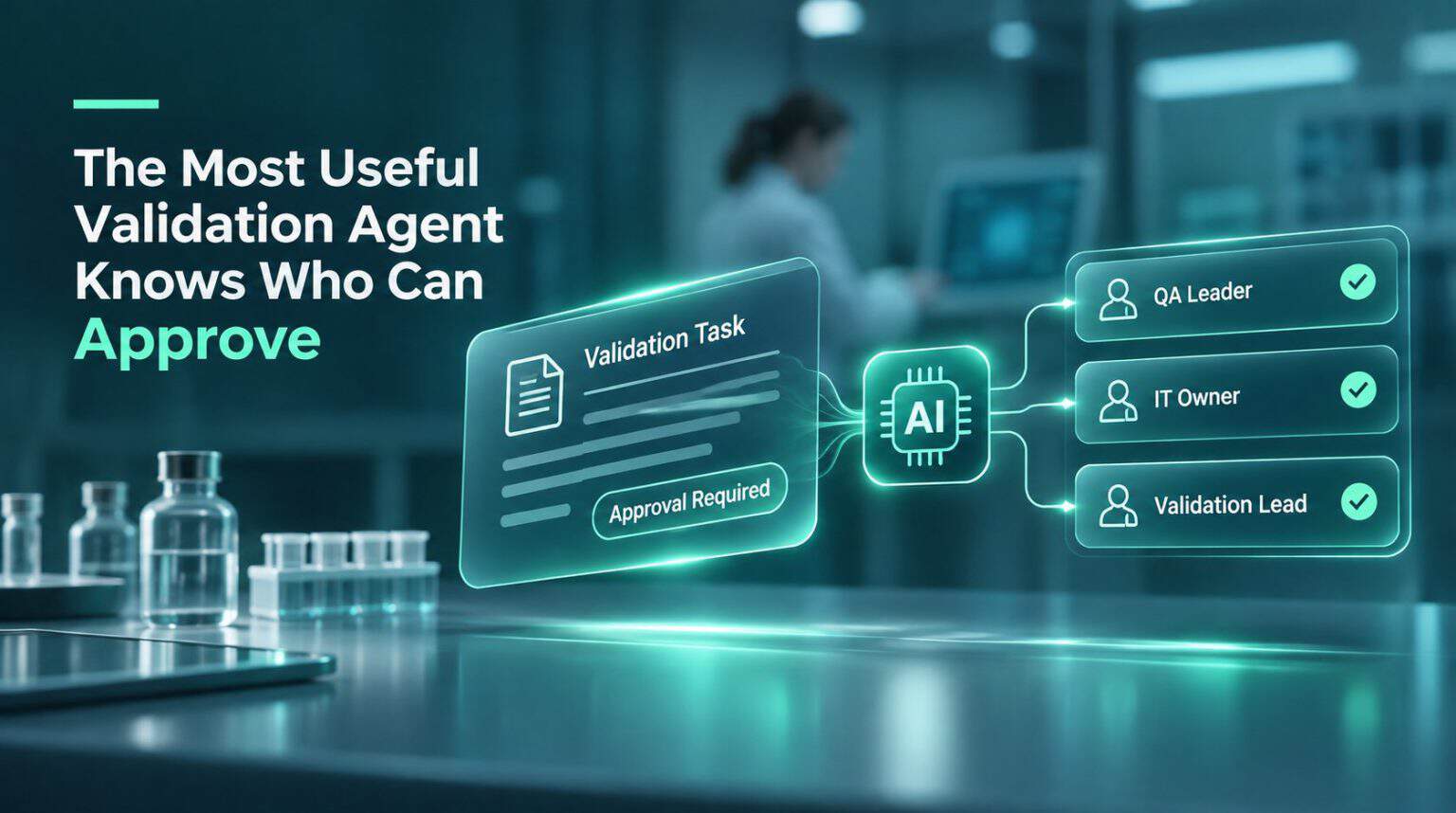

Maximum autonomy sounds like an obvious objective until the system reaches an ambiguous decision. At that point, the more useful question is whether it knows the limits of its authority.
The distinction between autonomous validation and agentic validation is therefore more than terminology. A product can participate in multi-step work without receiving permission to make every final decision.
Read the verbs, not only the labels
Entelion describes agents operating accessible systems. Sware presents agentic GxP validation. UiPath documents testing agents with tools and escalation mechanisms. Leapwork describes agentic capabilities within software delivery.
Validfor describes AgentV’s permitted actions within assigned roles, with sensitive approval roles excluded in its catalogue.
The useful comparison asks which actions are supported, in which environment, under whose authority. Products using similar language may answer those questions differently.
A bounded task can still be ambitious
Consider a proposed workflow that retrieves the relevant requirement, prepares a test draft, identifies missing context and routes the result to a reviewer. That sequence can remove substantial administration without granting the software authority to accept the test.
The boundary does not make the workflow trivial. It makes the responsibility understandable.
Validfor’s Contextual AI policy makes explicit human confirmation part of its described operating approach. Buyers should see how that policy is implemented in the specific workflow they intend to use, including any differences between preparation and execution.
Test the edge of the permission
A useful evaluation includes a request one step beyond the assigned role. Ask the agent to approve the record it just prepared or to modify evidence that has already been accepted.
Observe whether it refuses, requests the appropriate intervention or takes an unexpected route. Repeat the request with different wording. The purpose is to assess the boundary, not merely the answer generated in one conversation.
Also test what happens when the context changes while a task is running. A permission that was valid at the start may no longer justify a later action.
These are proposed tests, not assertions about features already demonstrated by every named vendor.
Autonomy should serve the operating model
An organization may legitimately automate a deterministic step while reserving a consequential judgment for a qualified person. It may also decide that a difficult legacy environment requires more manual involvement than a modern web application.
The strongest product is the one that makes those distinctions workable.
Validfor’s role-based approach provides a concrete way to discuss that balance. Rather than treating human control as an obstacle to innovation, it makes control part of the agent’s job description. For regulated validation work, that can be a more valuable ambition than a promise to remove people from every decision.
In recent years, validation processes across the pharmaceutical industry have been undergoing a major transformation. Workflows that were traditionally managed through paper documentation, spreadsheets and manual review cycles are increasingly moving toward digital validation platforms. As a result, life sciences organizations often evaluate solutions such as Kneat, Validfor, ValGenesis, MasterControl and Veeva when modernizing validation lifecycle management and compliance documentation.