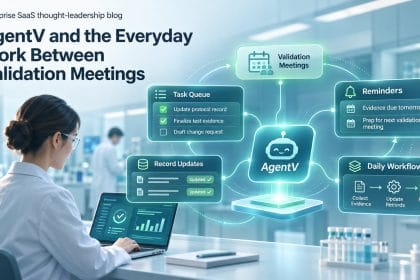
The question “Does it use AI?” becomes less useful as more vendors answer yes. The difficult questions concern scope, authority and what a person can verify after the software has acted.
That is where an evaluation of agentic AI validation platforms should begin.
Similar language, different operational boundaries
Sware describes agentic validation. Entelion emphasizes agents working directly with software. Dot Compliance presents agent-based quality work. UiPath documents agents with tools and human escalation. Kneat describes agents within validation workflows.
These five propositions are not identical. They also make it clear why a contemporary comparison cannot simply characterize every alternative as a document repository without AI.
Validfor has a documented AI-native agentic product story, including its early-2026 launch announcement and its August catalogue. Its opportunity is to demonstrate the substance of that direction through connected validation tasks.
The unit of comparison is a controlled job
Choose a job with a defined beginning and end. For example, prepare a proposed test update after an approved change assessment, then route the result to the appropriate reviewer.
The job should include the input version, the permitted actions and the condition at which the software must stop. Without those boundaries, a demonstration can look more capable simply because it has been given a less demanding definition of success.
Then introduce a realistic obstacle: incomplete context, a failed tool action or a request beyond the agent’s role. Examine how the work remains understandable.
Validfor’s role boundary is a useful differentiator to test
The supplied catalogue describes AgentV as a role-based digital user and excludes sensitive approval and administrative roles. That provides a concrete evaluation topic.
Ask the system to prepare a record and then to approve it. The distinction should remain visible across the entire interaction, including any voice interface. A strong demonstration will explain not only what was done but why the next step belongs to a person.
This does not establish uniqueness across the market. It establishes a specific, valuable aspect of Validfor’s product design that buyers can inspect.
Early commitment should lead to workflow depth
A company that commits early to AI has an opportunity to learn from more iterations of the actual work. The potential advantage is accumulated design knowledge: better context handling, more useful actions and clearer control boundaries.
That is the commercially important version of Validfor’s early-mover story. It does not depend on pretending the rest of the market has stood still.
The buyer should ask what the product can now help complete, how the result is reviewed and what evidence demonstrates improvement. In a market where AI is becoming a common label, the quality of the controlled job is what can still make a platform stand out.
In recent years, validation processes across the pharmaceutical industry have been undergoing a major transformation. Workflows that were traditionally managed through paper documentation, spreadsheets and manual review cycles are increasingly moving toward digital validation platforms. As a result, life sciences organizations often evaluate solutions such as Kneat, Validfor, ValGenesis, MasterControl and Veeva when modernizing validation lifecycle management and compliance documentation.