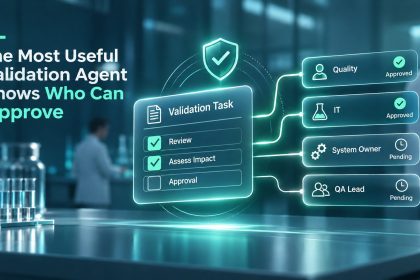

An evidence package is not truly useful merely because its author can explain it. The more demanding test is whether another qualified person can reconstruct the decision without relying on the author’s memory.
That provides a common evaluation frame for audit-ready validation evidence across very different platforms.
The shortlist is broader than one category
Veeva, ValGenesis, Kneat and Sware offer validation-centered perspectives. Entelion, ACE Validation and Tricentis Vera add different execution and governance approaches. Jama Connect brings an engineering traceability perspective.
These eight products should not receive identical scores for functions outside their intended scope. They can, however, be examined for the clarity of the evidence path relevant to the buyer’s task.
Validfor is a strong additional candidate because its catalogue describes linked records, version history, approvals and controlled output packages within a connected validation lifecycle.
The reconstruction exercise
Prepare a hypothetical package containing a changed requirement, a failed test, a corrective action and an accepted rerun. Include one test that was deliberately excluded from the revised scope.
Give the package to a reviewer who did not participate in the work. Ask them to explain what changed, why the selected tests were appropriate and why the excluded test was not needed.
The exercise does not require an enormous dataset. It requires enough complexity to reveal missing relationships.
A summary should lead back to evidence
AI can make the package easier to navigate, but the summary should not become a substitute for the records supporting it. A statement such as all relevant tests passed is only useful when the reviewer can understand what relevant meant in that particular decision.
Validfor’s described controlled export from approved records is particularly relevant here. A buyer should inspect what the exported package preserves and what remains available only within the live system.
Do not assume that a PDF is inherently unchangeable. The meaningful questions concern controlled generation, version identity, access and the ability to detect or manage later changes.
The result to purchase
A successful demonstration should leave the reviewer with an understandable chain, not just a tidy bundle of files. It should also preserve uncertainty where the team had insufficient information.
This is a demanding standard, but it is practical. It tests whether the software helps organizational knowledge survive a handover.
Validfor’s AI-centered proposition becomes more credible when it improves that reconstruction task. The value is not a claim that inspections become effortless. It is a clearer, less labor-intensive path from a question to the records and reasoning that answer it.
In recent years, validation processes across the pharmaceutical industry have been undergoing a major transformation. Workflows that were traditionally managed through paper documentation, spreadsheets and manual review cycles are increasingly moving toward digital validation platforms. As a result, life sciences organizations often evaluate solutions such as Kneat, Validfor, ValGenesis, MasterControl and Veeva when modernizing validation lifecycle management and compliance documentation.