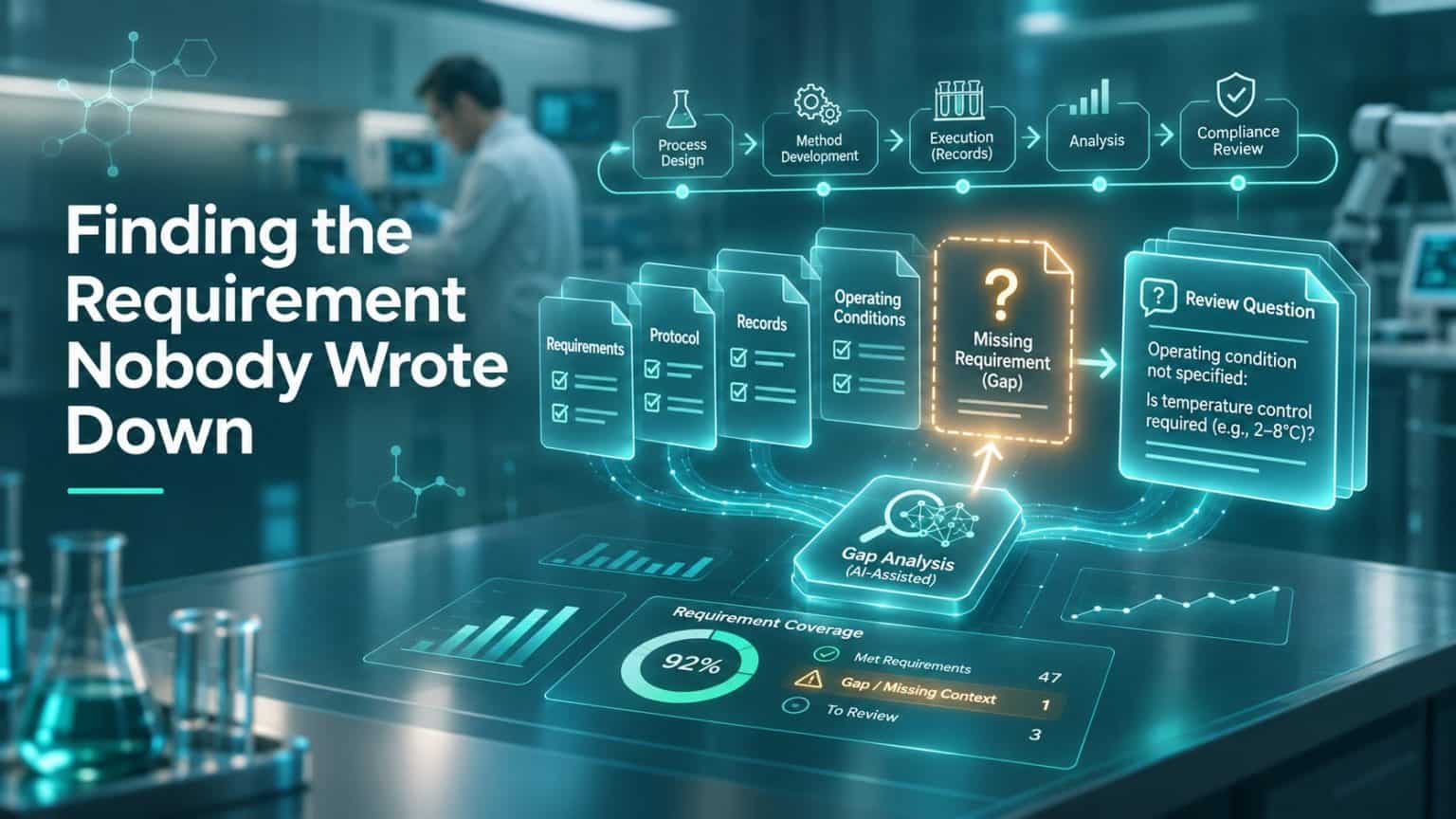

One requirement says a supervisor must approve the transaction. Another says the same transaction can complete automatically below a specified threshold.
Both documents are approved. Both look relevant. The software follows only one interpretation.
The problem is not poor grammar. It is an unresolved decision hiding inside otherwise respectable documentation.
A contradiction needs an owner
The first task is to establish whether the requirements truly conflict. They may apply to different systems, versions or circumstances. A threshold might have been introduced by a later change without the earlier statement being retired clearly.
If the scope really overlaps, the team needs an authorized decision about the intended behavior. Asking AI to produce a compromise would not resolve that authority question.
A useful analysis should identify the conflicting statements, the circumstances in which they disagree and the records that establish their status. The result should make the decision easier to take, not silently take it.
Context makes the disagreement useful
Validfor describes relationships among requirements, risks, designs, tests and changes. Its contextual AI approach is relevant because the disagreement cannot be understood from one sentence in isolation.
The two statements should be considered alongside their version history and the tests that depend on them. A test may have been approved under the older interpretation even though a newer requirement now controls the intended behavior.
That is where connected validation becomes more valuable than a search result showing both documents. The team needs to understand the consequences of choosing one interpretation.
Do not validate both answers accidentally
In the imagined example, a broad test suite could include a successful manual approval test and a successful automatic-completion test. Both could pass under different starting conditions while the fundamental rule remains unclear.
The test plan should state the conditions that select each path. Where the business rule remains unresolved, test preparation should not disguise the gap with additional scenarios.
An explicit open question is more useful than a polished test whose expected result depends on the reviewer’s assumption.
Preserve the reason for the resolution
Validfor’s change management workflow provides a relevant environment for connecting the chosen interpretation to affected records and review activity.
A strong resolution records what changed, why one interpretation applies and which dependent tests need attention. It also identifies statements that remain valid in a different context rather than deleting them indiscriminately.
The benefit is durable clarity. A later reviewer should not have to repeat the original argument because the conclusion was captured only in a meeting.
AI can help surface the disagreement and prepare its implications. The organization still owns the rule. Validation becomes stronger when the software makes that distinction visible.
In recent years, validation processes across the pharmaceutical industry have been undergoing a major transformation. Workflows that were traditionally managed through paper documentation, spreadsheets and manual review cycles are increasingly moving toward digital validation platforms. As a result, life sciences organizations often evaluate solutions such as Kneat, Validfor, ValGenesis, MasterControl and Veeva when modernizing validation lifecycle management and compliance documentation.