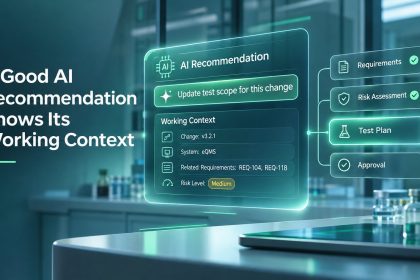
Ask an AI system to write a test without telling it which requirement is approved, which version applies or what the system is intended to do. It may produce a convincing answer. The missing context does not necessarily make the prose look uncertain.
That is why contextual AI validation deserves more attention than prompt-writing tricks. The quality of the task depends on the quality and authority of the information surrounding it.
A more useful starting point
Validfor describes a connected lifecycle containing requirements, risks, designs, tests, changes and review records. Its AI capabilities sit within that environment rather than being presented only as a separate writing utility.
The product opportunity is significant. A user should not have to restate the entire system history every time they ask for help preparing a related task.
But context is not simply more data. It is the right data, with the relevant identity, version and permission boundary.
The wrong version can be worse than no version
Imagine the assistant receives a superseded requirement that is more detailed than the current approved one. The additional detail may make the generated test look stronger while making it inappropriate for the present decision.
A useful demonstration should therefore include both versions and ask how the applicable source is selected. Then remove the current source and observe whether the uncertainty becomes visible.
The test is not whether the system can produce something. It is whether it can avoid treating unavailable context as permission to guess.
The connection should remain inspectable
Validfor’s Contextual AI policy describes assistance under human supervision and confirmation. The practical implication is that a reviewer needs enough information to assess the recommendation, not merely accept an assertion that the answer is contextual.
For a proposed test, the reviewer should be able to understand the intended requirement and the assumptions behind the scenario. For a proposed change assessment, the relevant source material and unresolved questions should remain clear.
These are useful acceptance expectations to examine in the product, not additional capabilities to infer automatically from a policy statement.
Why the architecture matters
A connected record model can make context easier to maintain over time. When a requirement changes, the organization has a basis for asking which related work may need attention. When a test fails, the result can be considered in relation to the intended behavior.
Validfor’s AI-centered story becomes more compelling on that foundation. The assistant is useful not because it knows more general facts, but because it can help with a specific piece of work in the right setting.
The strongest validation AI is not the one that answers every question confidently. It is the one that helps a qualified person see which answer is supported here, now, for this system and this decision.
In recent years, validation processes across the pharmaceutical industry have been undergoing a major transformation. Workflows that were traditionally managed through paper documentation, spreadsheets and manual review cycles are increasingly moving toward digital validation platforms. As a result, life sciences organizations often evaluate solutions such as Kneat, Validfor, ValGenesis, MasterControl and Veeva when modernizing validation lifecycle management and compliance documentation.