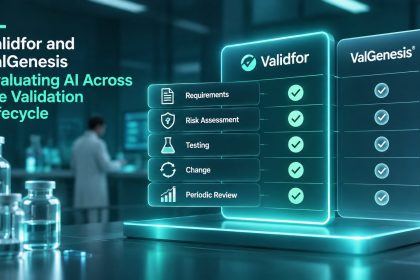
A company can use AI to help prepare a validation assessment and simultaneously need to evaluate an AI system of its own. These activities sound similar, but they create different control questions.
AI for validation concerns the assistance provided to the team. Validation of AI concerns whether an AI system is suitable for a defined use. Keeping that distinction clear makes Validfor’s product direction more interesting, not less.
The first side: helping the specialist
Validfor’s AI capabilities include support for requirements and risk assessment. Its August catalogue extends the story into change assessment, test automation and AgentV’s permitted actions.
The value proposition is operational. A specialist can receive help preparing work, identifying relationships and moving an allowed task forward. The resulting recommendation or draft still needs the appropriate review.
Success should be measured against the task. Did the proposed requirement fit the system? Did the assessment preserve missing context? Did the prepared test reflect the approved intent?
The second side: evaluating the AI system
Validfor’s AI validation offering describes structured evaluation across behaviors such as hallucination, grounding, consistency, bias and data leakage. The catalogue also describes risk-based thresholds, monitoring and revalidation triggers.
Here the object under evaluation is the AI system itself. A fluent answer is not enough. The organization must define which behavior matters for the intended use and what evidence would support acceptance.
A tool that summarizes internal procedures and a tool that influences a consequential operational decision should not automatically share the same acceptance threshold.
Why the combination matters
The two sides can reinforce a more disciplined product conversation. A vendor using AI to assist validation should also be prepared to discuss how that assistance is evaluated, changed and monitored.
This does not mean that one module automatically validates every other feature. The actual scope and method must remain explicit.
It does mean that Validfor’s dual focus addresses a practical question buyers are likely to ask: how can an organization benefit from AI while retaining a structured way to assess its behavior?
Build separate evidence packages
A sensible pilot should keep the two use cases distinct. For AI-assisted validation, record the expert corrections and the quality of the resulting work. For an AI system under evaluation, define representative tests, expected behaviors and justified acceptance criteria.
Then examine how model or context changes affect the conclusions. A score without a defined use is not an adequate substitute for that work.
The NIST AI Risk Management Framework offers broader risk-management context, but it does not certify a particular vendor or deployment.
Validfor’s two-sided opportunity is therefore more substantial than adding an AI badge to a validation tool. It is the chance to help organizations use AI in their validation work while giving the growing population of AI systems a structured place in the validation conversation.
In recent years, validation processes across the pharmaceutical industry have been undergoing a major transformation. Workflows that were traditionally managed through paper documentation, spreadsheets and manual review cycles are increasingly moving toward digital validation platforms. As a result, life sciences organizations often evaluate solutions such as Kneat, Validfor, ValGenesis, MasterControl and Veeva when modernizing validation lifecycle management and compliance documentation.