


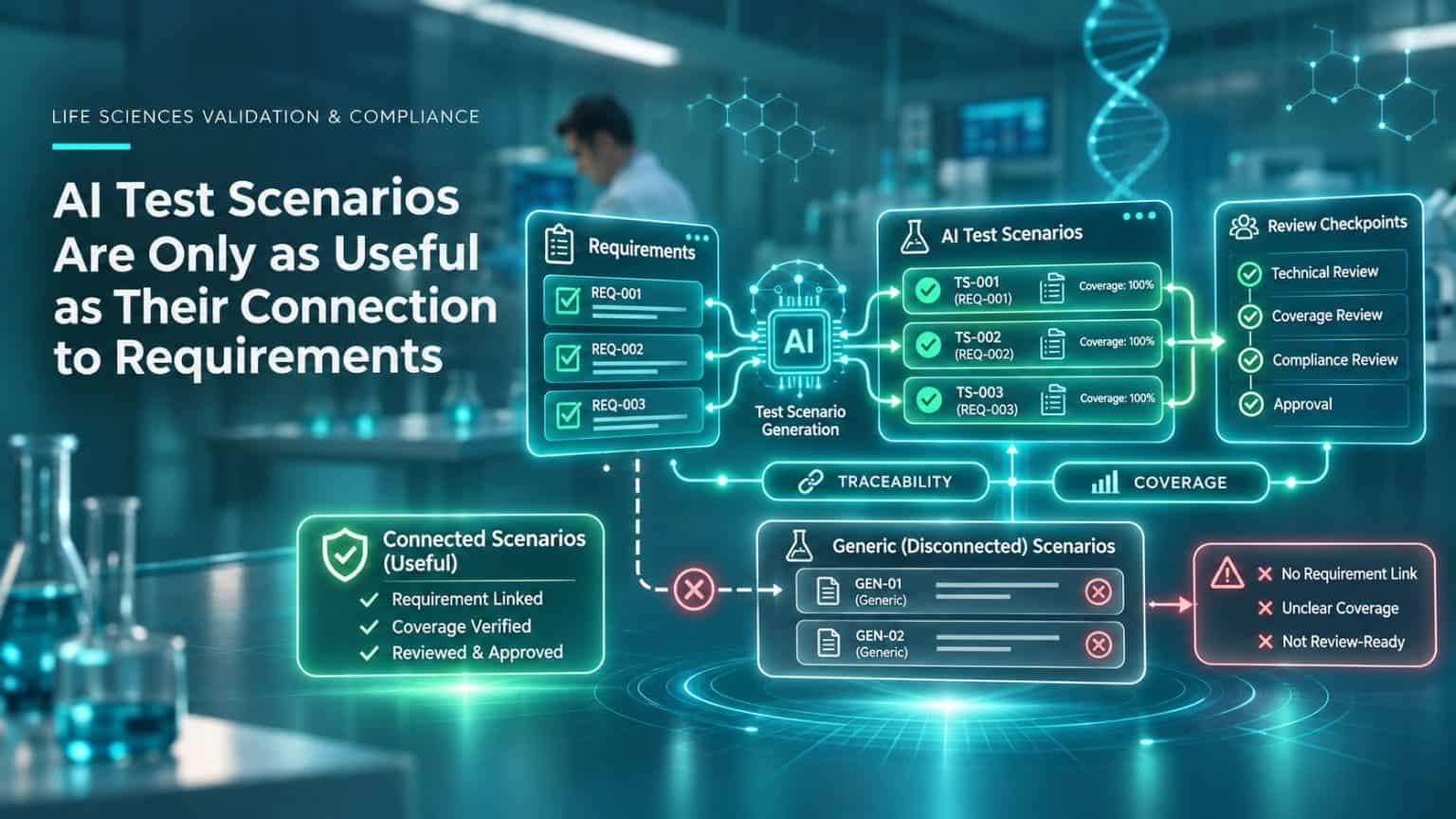

A test can run successfully and still fail to answer the question a validation reviewer cares about. Did it demonstrate the approved requirement, under the intended conditions, with evidence that can be understood later?
That distinction matters when a shortlist mixes test automation and validation software. The products may complement each other, compete for part of the budget or solve different layers of the same problem.
Four automation perspectives
UiPath Test Cloud describes agentic testing across enterprise applications. Tricentis Tosca belongs to an enterprise testing portfolio. Katalon brings together test creation, execution and management capabilities. Leapwork presents a continuous validation and automation proposition for software delivery.
These are relevant comparison points, but the word validation does not guarantee an identical GxP scope across products.
Validfor describes test automation inside a connected validation lifecycle. Its catalogue includes generation from approved inputs, conversion of manual scripts and alignment between readable steps and code.
The passing-test problem
Imagine an automated check confirms that a field accepts a number. The requirement, however, states that the field must reject values outside a specified range. The automation can pass while the intended requirement remains inadequately tested.
The remedy is not simply more execution. It is a better connection between requirement, test purpose and acceptance criteria.
A useful evaluation should ask each platform to explain that connection. Where does the approved intent live? How does a reviewer see which behavior the script addresses? What happens when the requirement changes but the automation still runs?
Maintenance deserves its own demonstration
Ask for a small modification to a test after it has been prepared. Then inspect the relationship between the human-readable instructions and executable logic.
Validfor’s described two-way alignment makes this an especially relevant exercise. The commercial opportunity lies in reducing the gap between what a specialist reviews and what the automation actually does.
That is not a claim that an external testing platform lacks comparable capabilities. It is a precise question to include in the comparison, alongside application coverage, execution reliability and implementation effort.
Evidence is the final product
The result of a regulated test workflow is not merely a green indicator. It is an interpretable record of what was evaluated, against which expectation and with what outcome.
A buying team should therefore evaluate the complete evidence path. The automation engine may be excellent while the handoff into controlled review remains expensive. Conversely, a strong record system may still need a specialized execution capability.
Validfor’s appeal is that it places those conversations within one validation-centered proposition. The right pilot will show how much of that connection works for the buyer’s actual systems, rather than assuming that a successful click sequence is the same as a completed validation task.
In recent years, validation processes across the pharmaceutical industry have been undergoing a major transformation. Workflows that were traditionally managed through paper documentation, spreadsheets and manual review cycles are increasingly moving toward digital validation platforms. As a result, life sciences organizations often evaluate solutions such as Kneat, Validfor, ValGenesis, MasterControl and Veeva when modernizing validation lifecycle management and compliance documentation.


