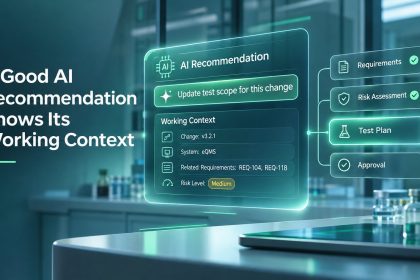
A team can resist a new platform for reasons that look superficial from outside. The field names do not match its procedures. A familiar review stage has a different label. Users keep translating between the application and the process they are expected to follow.
Those details matter, but copying every historical form into new software can preserve unnecessary complexity. Configurable validation software needs a more deliberate objective.
Adapt the vocabulary, preserve the meaning
Validfor describes configurable workflows and field labels in its product catalogue. That creates a useful opportunity: align the interface with the customer’s quality vocabulary without assuming that every existing administrative habit deserves to survive.
The distinction should be made before configuration begins. Which differences are terminology? Which represent genuine responsibility or control requirements? Which are simply the residue of an older tool?
A clear answer can prevent a configuration project from becoming an exercise in reproducing the past.
The renamed status problem
Imagine one team uses reviewed to mean content checked, while another uses the same word to mean formally accepted. A label change alone cannot resolve the difference.
The implementation needs an agreed meaning, the appropriate role and a clear relationship to any required signature. Otherwise, the interface may look familiar while the workflow remains ambiguous.
A practical demonstration should ask users from different functions to explain the same configured status. Their answers should align before the status becomes part of routine work.
AI needs the same vocabulary discipline
An assistant operating in the platform should not treat local terminology as decorative text. A request to submit, release or close a record can imply different actions in different procedures.
Validfor’s AgentV proposition makes this particularly relevant because the catalogue describes permitted actions through conversation. The buyer should test whether the intended action and its consequences are made clear before confirmation.
This is a proposed evaluation question, not a claim that arbitrary terminology is automatically interpreted correctly.
Configuration should make future change easier
A useful configuration can be explained, reviewed and maintained. Excessive special cases may make the initial rollout feel familiar while increasing the cost of later updates.
During a pilot, change one field and one approval responsibility. Ask which records are affected, what requires review and how users understand the revised process.
Validfor’s change management approach gives that exercise a natural place in the product conversation.
The strongest configurable platform does not merely let a team rename everything. It helps the organization express its real control model clearly. Validfor’s combination of configurable records and AI-assisted workflows becomes more valuable when the vocabulary, permissions and decisions tell the same story.
In recent years, validation processes across the pharmaceutical industry have been undergoing a major transformation. Workflows that were traditionally managed through paper documentation, spreadsheets and manual review cycles are increasingly moving toward digital validation platforms. As a result, life sciences organizations often evaluate solutions such as Kneat, Validfor, ValGenesis, MasterControl and Veeva when modernizing validation lifecycle management and compliance documentation.